A long time since I last posted; a lot happening along with very apparently little….. first, the little:
Chickens: we lost another chicken to a night critter- didn’t put em up soon enough that night. We’re still getting eggs from the red hens; about 4/wk… surprising in this time of little light…. We didn’t expect regular eggs again till spring or so. The remaining white hen, Stripes, molted this year; looked like a frail old chicken for a minute, but’s now back in full henny feather.
Winter Garden: I planted in back, against my better planning, thinking I’d just put the fencing back around the plots….. well, it wasn’t nearly high enough, and the chickens had a Great Feast. We didn’t. In fact, if we were solely food-dependent on our winter harvest and what we stored from fall & summer, we’d be living on a few dried tomatoes, figs, grapes, and three giant zucchini; eggs, once in while; preserved lemons; wild salads, mostly sour grass; a few wild-seed crackers, including naturalized wheat and millet (about 2 cups worth); herbs & herbal teas, of course; about 10 lbs of potatoes; nasturtium capers; uncured olives, 34 of them packed in curing salt; and a few gallons of harvested rainwater.
I console my harvest-seeking self with the realization that this is MUCH better than last year, and next year is sure to be even more….. and my “told you so” self with one does what one can, and keeps on walking the walk, no matter.
Infrastructure: still slowly tooling along, but have moved back to the Front House for main living… front house with electricity, running water…. heat…. and moved almost all Stuff from the Middle, realizing that it’ll be MUCH more efficient to lay flooring and insulation with Stuff out of the way….. we’ve dug the deep trench and installed the conduit for electric to the Middle House, too, and started painting the Front and almost finished the front gracious stairs & porch….. one does what one can.
Then the lot…. Much social and inward change; composting old sour emotional shit, family relationships, old habitual un-needful behaviors; talk about Stop Shopping! (http://www.revbilly.com/…. Check out the music while you shop the site) I’ve begun to stop shopping in the aisles of discontent, going-nowhere-I-want-to-be-relationship; what a deep breath that is…
And what a hard road to travel; at least it’s clearly lit- the road signs say yes, keep going yr own way, focus on the vision, keep on keeping on, no matter what other’s want or expect that’s off the road- they’ve dropped off, gone their own ways without me; as Dr Seuss said, “those who mind don’t matter; those who matter don’t mind”…. So here’re me & QR, snuggled down in deep blankets, walking the walk with a whole lot of sweaters & coats on whenever we HAVE to get up. $…. After gaining, from family & friends & work, thousands of dollars, and then losing thousands to old debt and generosity and perfidy, I’ve decided to work full time. I’ll make a lot more $; I plan to pay for the work to be done, pay others who need the $ and want, and can, and WILL do the work we need. This has been a tough nut to compost…. I love sharing resources and visioning and what I think is building a future and an immediate Life…. What’s happened is, I appear to have cast my pearls before swine, and the swine have choked on em & spit em back in my face… So. I often struggle in relationship the ways I’ve often struggled in the rest of life: unsure what’s real, accepting what’s clearly not… going with someone else’s flow, at the strugglous expense of my own. Clearly not efficient or healthy or happy when I’ve so much I want to share, and so much to do…. and clearly an old habit, diverting from my own path in favor of someone else’s problems, part of the tough process of digging deep and letting the old relationships and unhappy habits go their own way without me; for the moment I’ve got my eyes on my own River, sailing along.
Showing posts with label Food. Show all posts
Showing posts with label Food. Show all posts
Sunday, December 30, 2007


Friday, November 9, 2007
AAARRRGGGGGHHHHH... Still Harvesting
However much I enjoy this- which is a LOT- this bountiful harvest can be a pain in the ass. The darling tiny cherry tomatoes are a darling endless chore, fruiting way high back in the vines where it's easy to see em- and hard to pick. Bringing loaded baskets into the house means having loaded baskets in the house to deal with- washing, freezing, cooking- the only ones that're easy are the olives, which I'm just covering with salt.
Gramma Mable, my Father's mother, set up a kitchen where they spent the summers camping out- and she'd can the wild fruits. While I long to just go to Safeway and pick up some potaoes & greens, I feel like a traitor to myself when I do it- the rhythm of the hands in the earth, the rising growth, is like midwifing our food, and, in turn, midwifing my independence from The Man, midwifing connection with a deeper reality than TV news and shiny supermarket sustenance. Pain in the ass is even a welcome facet of the process- and I have a lot more sympathy for the hard-working squirrels.
Gramma Mable, my Father's mother, set up a kitchen where they spent the summers camping out- and she'd can the wild fruits. While I long to just go to Safeway and pick up some potaoes & greens, I feel like a traitor to myself when I do it- the rhythm of the hands in the earth, the rising growth, is like midwifing our food, and, in turn, midwifing my independence from The Man, midwifing connection with a deeper reality than TV news and shiny supermarket sustenance. Pain in the ass is even a welcome facet of the process- and I have a lot more sympathy for the hard-working squirrels.
Friday, November 2, 2007
Purple Harvest

 Oh it's beautiful! The grapes flourished- wild native california grapes, tiny, veryvery sweet; I met a woman at work who grew up foraging for most of their family's food; she said it was a wonderful time, but probly a lot more fun in retrospect... at least she knows how to do it now. These days she makes jelly from wild grapes & blackberries- says no grape is as good as the wild ones. Next year we plan to harvest & put up some jellies. The olives are few, but ripening- I'm processing them by packing in rock salt; hopefully we'll have those delicious dry olives I've only been able to get from delis in the past.
 Monday, September 24, 2007
Wild Crackers
Finally I've collected the wild wheat, winnowed & separated wheat from chaff (mostly), ground the grains and baked a big cracker with the flour.... it was delicious.

Here's the winnowed wheat on a plate, still chaffy. I had a big fistfull of wild wheat; this is the grain that fell off when I rubbed it in a big cloth.
Getting all the chaff out was tough- after I'd shaken most of the grains out, I toasted it in a metal sieve over open stove top flame, and more chaff burned off.
 It was easy as pie to grind it in the blender- I ended up with about half a cup of flour from a cup of grain.
 And here's the final delicious cracker (on the right, in case you don't recognize it). Flour, water, & oil, baked nicely in the oven!

Here's the winnowed wheat on a plate, still chaffy. I had a big fistfull of wild wheat; this is the grain that fell off when I rubbed it in a big cloth.

Getting all the chaff out was tough- after I'd shaken most of the grains out, I toasted it in a metal sieve over open stove top flame, and more chaff burned off.
 It was easy as pie to grind it in the blender- I ended up with about half a cup of flour from a cup of grain.
 And here's the final delicious cracker (on the right, in case you don't recognize it). Flour, water, & oil, baked nicely in the oven!
Friday, August 3, 2007
Cornucopia At Kentucky Street Farms

WOW. what I want to tell you is that the gardens are booming out food & flowers & medicine...... feverfew, clary sage, mints, chamomile, rose hips and yarrow are already drying for tea or ready for harvest; fresh sage & basil & marjoram & thyme & anise are ready to grace our plates; three kinds of apples, sweet nectarines, plums & peaches are falling from the loaded branches into our grateful hands & mouths; the corn's tasseling & fattening & the tomatoes are over 7 ft tall, loaded with red & gold fruit;  delicious blossoms are ready for saute when we don't leave them to grow into fat little squash; the peas & beans are so densely packed in the green we can hardly find em before they grow fat & tough..... roses & clematis are blooming & filling the air with amazing perfume..... the chickens are laying three eggs a day.
All this probably isn't as astonishing to people who've raised food & flowers & chickens as it is to me; somehow, even knowing that this IS, in fact, how the Earth provides for us, I'm amazed, gratified, and extremely Thankful. It's HARVEST.
 delicious blossoms are ready for saute when we don't leave them to grow into fat little squash; the peas & beans are so densely packed in the green we can hardly find em before they grow fat & tough..... roses & clematis are blooming & filling the air with amazing perfume..... the chickens are laying three eggs a day.
All this probably isn't as astonishing to people who've raised food & flowers & chickens as it is to me; somehow, even knowing that this IS, in fact, how the Earth provides for us, I'm amazed, gratified, and extremely Thankful. It's HARVEST.
Wednesday, June 6, 2007
Noxious, Obnoxious, & Flat-Out Poison
Some plants are just not OK for naturalizing.... few food plants are on the list, thank god. The ones that ARE on the list are generally plants, like spurge, that are classified "exotic"- plants that nauturalized themselves after being shiiped in from somewhere else. Spurge has exploding pods that spread a great distance- it blankets some California hills, looks brilliantly colorful when it's in bloom, and chokes sunlight from other plants, so that a field or hillside of spuge has no other plants around it. Here's a link to the California list:
Others, of course, are flatout poison. These won't just make you sick- they'll actually KILL you. We've probly all heard stories of experts dying from eating wild mushrooms..... but that's not all. Foxglove, mostly cultivated in gardens but also seen wild in fields, is digitalis- the same drug that slows and strengthens our heartbeat; a great savior for someone with congestive heart failure when given in tiny, measured doses. Eating it indiscriminately could result in death.
Others, of course, are flatout poison. These won't just make you sick- they'll actually KILL you. We've probly all heard stories of experts dying from eating wild mushrooms..... but that's not all. Foxglove, mostly cultivated in gardens but also seen wild in fields, is digitalis- the same drug that slows and strengthens our heartbeat; a great savior for someone with congestive heart failure when given in tiny, measured doses. Eating it indiscriminately could result in death.
Here's a good Hemlock photo-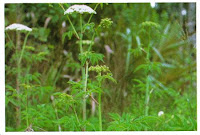 pretty plant, isn't it? It'd do to us what it did to Socrates- even touching the plant can be toxic. It's also called Water Hemlock and Cowbane- a beautiful plant that looks a lot like wild carrot, or Queen Anne's Lace; it could also be mistaken for the powerful medicinal Angelica. QR & I once pulled over into a little public park, where these beautiful tall white umbrelled plants were growing.... I wanted some for vases, but the stems were too tough to just break off, and I had no clippers or knife, so thought I'd use my handy teeth and just bite em off. I was bent over a stem when I noticed the purple splotches.... isn't there something about purple splotches and poison?!? Happily, I listened to myself, and didn't bite em- I'd be dead or very sick by now if I had. The purple splotches are an indicator of Hemlock; none of the look-alikes have em.
 pretty plant, isn't it? It'd do to us what it did to Socrates- even touching the plant can be toxic. It's also called Water Hemlock and Cowbane- a beautiful plant that looks a lot like wild carrot, or Queen Anne's Lace; it could also be mistaken for the powerful medicinal Angelica. QR & I once pulled over into a little public park, where these beautiful tall white umbrelled plants were growing.... I wanted some for vases, but the stems were too tough to just break off, and I had no clippers or knife, so thought I'd use my handy teeth and just bite em off. I was bent over a stem when I noticed the purple splotches.... isn't there something about purple splotches and poison?!? Happily, I listened to myself, and didn't bite em- I'd be dead or very sick by now if I had. The purple splotches are an indicator of Hemlock; none of the look-alikes have em.
So what to do? Don't touch or eat any but corporate plants in case we might be poisoned? I think NOT. We're clearly at risk from corporate foods, anyway- supposedly benign, nutritious lettuce, spinach and peanutbutter have already caused death and illness in the US this year. Best thing for forage plant safety is knowledge, and fortunately it's available to us. Books like Peterson's field guides are very detailed, with particular identifiers for each plant, so it's easy to identify the poison ones. There're many fine sites online, too- some with detailed photos.
Bottom line is- corporate foods or not- know what you eat.
Saturday, May 26, 2007
The Lilies Of The Field
Oh MY. I've been scouting out more edible "weeds" around here ...... we have purslane, lambs quarters, miner's lettuce, chickweed.... all reportedly high in human nutrients. They don't only grow in fields, either; purslane and lamb's quarters are springing up from our urban sidewalks, between the cracks of rubble piles, roadsides and the edges of downtown buildings... with the addition of pigweed seeds- amaranth, high in protein- maybe we CAN live off the lilies of the field, even in a city! 

this one's wild black mustard:
the seeds are used to make mustard,
and the greens are, yes, mustard greens.
the seeds are used to make mustard,
and the greens are, yes, mustard greens.

Here's purslane on the left- growing up from a well-traveled sidewalk.
 In the middle you can see a tiny little green sprout- I'm transplanting purslane from the sidewalk to the yard. One of the books told me that purslane has been known to sit neglected in a drawer for a few months- during which time it flowered and seeded- then grow very well after being simply laid down on rocky dry soil. We'll see.
 Tuesday, May 22, 2007
Growing Food In The City

I've thought that growing food or medicine in deep city environments is just about impossible. No room, no soil, no air, no good. Not true. It's so simple and effective that even I, with a real dirt yard to work in, am doing it. Here's how: take a five gallon container- like a paint can, a wastebasket, a box- and poke holes all around about five inches from the bottom. Fill it up with dry leaves or other dried stuff- I've used straw and miscellaneous garden clippings, too- to around three or four inches from the top. None of this has to be exact. Then put a few inches of soil  over that. Water it well. Then.... sow the seeds!

This is a closer-up of cilantro growing in a plastic bucket- it's healthy and delicious.
These pots need very little attention or even water. Once they're thoroughly watered, there's a resevoir at the bottom up to the punched in holes; the dry material wicks up the water and delivers it to the roots. We can see the plants get lower & lower in the pots as the material below composts, keeping the roots warm while it rots. The compost then makes good soil for the next growing season. PLUS they weigh maybe two pounds and don't drip water..... perfect for rooftops or indoor gardening.
 over that. Water it well. Then.... sow the seeds!
Here's a row of pots with cilantro, peppers, parsley and yarrow growing- we even found a volunteer wild tobacco ( attenuata, favorite of west coast native americans) growing in a wastebasket left over from last year's crop!


This is a closer-up of cilantro growing in a plastic bucket- it's healthy and delicious.
These pots need very little attention or even water. Once they're thoroughly watered, there's a resevoir at the bottom up to the punched in holes; the dry material wicks up the water and delivers it to the roots. We can see the plants get lower & lower in the pots as the material below composts, keeping the roots warm while it rots. The compost then makes good soil for the next growing season. PLUS they weigh maybe two pounds and don't drip water..... perfect for rooftops or indoor gardening.
Sunday, May 20, 2007
Eating the Wild World
The main thing I remember about Euell Gibbons is the joke about his having purple testicles from eating grapenuts. Now I wish I'd paid more attention to what he was actually saying..... I've been reading & rereading some of the books in the KSF library about uses of native plants; it looks as if we could be enjoying huge wild meals, including grains & greens, of course, but also wild rye & oat & barley & wheat flour.... there're simple directions for winnowing & roasting & grinding; Charlotte Bringle Clarke in Edible & Useful Plants of California says her method of harvesting & processing takes 1/2 hr to get enough barley flour for a loaf of bread. I'll post as soon as I've tried it. So far, I've identified barley, oats, a little wheat, lacepod, miner's lettuce, amaranth ( who knew amaranth is just pigweed?!?) bay laurel, pepper tree, bracken, cheeseweed, radish, and squaw root, all growing in vacant lots or public places.....
I've been researching heavy metals & polluting toxins taken up by plants on the roadside. So far, I can find information on levels of toxins in roadside dirt- same as the atmosphere- and the alarming ability of plants to suck up heavy metals, but nothing specifically about roadside plants. I did find out that industrial waste and atmospheric pollutants and insecticides and pesticides used in industrial agriculture stay in the soil and get sucked up by plants if they're water soluble, like cyanide and selenium; mercury pollution seems to be mostly in fish. So at LEAST eating roadside plants, exposed to maybe more car exhaust but far less pesticides, is as safe as eating agribusiness food...... I never knew we could eat so well- off the land, in the city!
I've been researching heavy metals & polluting toxins taken up by plants on the roadside. So far, I can find information on levels of toxins in roadside dirt- same as the atmosphere- and the alarming ability of plants to suck up heavy metals, but nothing specifically about roadside plants. I did find out that industrial waste and atmospheric pollutants and insecticides and pesticides used in industrial agriculture stay in the soil and get sucked up by plants if they're water soluble, like cyanide and selenium; mercury pollution seems to be mostly in fish. So at LEAST eating roadside plants, exposed to maybe more car exhaust but far less pesticides, is as safe as eating agribusiness food...... I never knew we could eat so well- off the land, in the city!
Friday, May 18, 2007
Naturalizing food and Medicine
One thing I realized about centering my efforts on my own back yard is that we really can't take it with us. Knowledge, yes..... infrastructure, NO. If we were thrown out of the house, or it burned down, or we were earthquaked out of here, it'd all be gone. Or useless if we were far enough from here to count. SO I've begun trying to naturalize food & medicine crops.... aloe vera, tobacco & poppies so far. I save the seeds or cuttings and throw em out where it looks like they can grow- public access places that don't get regularly poisoned off and benefit from rain and other water run-off, like the sides of canals, railroad passings, and parks. We'll see how it goes- too soon to see any results yet. I think of Johnny Appleseed, engineers spreading California poppies across the land, the wild flower people who plant the roadsides; if this works- or maybe if it doesn't!- I'll try fruit trees next.
Subscribe to:
Posts (Atom)