A long time since I last posted; a lot happening along with very apparently little….. first, the little:
Chickens: we lost another chicken to a night critter- didn’t put em up soon enough that night. We’re still getting eggs from the red hens; about 4/wk… surprising in this time of little light…. We didn’t expect regular eggs again till spring or so. The remaining white hen, Stripes, molted this year; looked like a frail old chicken for a minute, but’s now back in full henny feather.
Winter Garden: I planted in back, against my better planning, thinking I’d just put the fencing back around the plots….. well, it wasn’t nearly high enough, and the chickens had a Great Feast. We didn’t. In fact, if we were solely food-dependent on our winter harvest and what we stored from fall & summer, we’d be living on a few dried tomatoes, figs, grapes, and three giant zucchini; eggs, once in while; preserved lemons; wild salads, mostly sour grass; a few wild-seed crackers, including naturalized wheat and millet (about 2 cups worth); herbs & herbal teas, of course; about 10 lbs of potatoes; nasturtium capers; uncured olives, 34 of them packed in curing salt; and a few gallons of harvested rainwater.
I console my harvest-seeking self with the realization that this is MUCH better than last year, and next year is sure to be even more….. and my “told you so” self with one does what one can, and keeps on walking the walk, no matter.
Infrastructure: still slowly tooling along, but have moved back to the Front House for main living… front house with electricity, running water…. heat…. and moved almost all Stuff from the Middle, realizing that it’ll be MUCH more efficient to lay flooring and insulation with Stuff out of the way….. we’ve dug the deep trench and installed the conduit for electric to the Middle House, too, and started painting the Front and almost finished the front gracious stairs & porch….. one does what one can.
Then the lot…. Much social and inward change; composting old sour emotional shit, family relationships, old habitual un-needful behaviors; talk about Stop Shopping! (http://www.revbilly.com/…. Check out the music while you shop the site) I’ve begun to stop shopping in the aisles of discontent, going-nowhere-I-want-to-be-relationship; what a deep breath that is…
And what a hard road to travel; at least it’s clearly lit- the road signs say yes, keep going yr own way, focus on the vision, keep on keeping on, no matter what other’s want or expect that’s off the road- they’ve dropped off, gone their own ways without me; as Dr Seuss said, “those who mind don’t matter; those who matter don’t mind”…. So here’re me & QR, snuggled down in deep blankets, walking the walk with a whole lot of sweaters & coats on whenever we HAVE to get up. $…. After gaining, from family & friends & work, thousands of dollars, and then losing thousands to old debt and generosity and perfidy, I’ve decided to work full time. I’ll make a lot more $; I plan to pay for the work to be done, pay others who need the $ and want, and can, and WILL do the work we need. This has been a tough nut to compost…. I love sharing resources and visioning and what I think is building a future and an immediate Life…. What’s happened is, I appear to have cast my pearls before swine, and the swine have choked on em & spit em back in my face… So. I often struggle in relationship the ways I’ve often struggled in the rest of life: unsure what’s real, accepting what’s clearly not… going with someone else’s flow, at the strugglous expense of my own. Clearly not efficient or healthy or happy when I’ve so much I want to share, and so much to do…. and clearly an old habit, diverting from my own path in favor of someone else’s problems, part of the tough process of digging deep and letting the old relationships and unhappy habits go their own way without me; for the moment I’ve got my eyes on my own River, sailing along.
Showing posts with label Gardening. Show all posts
Showing posts with label Gardening. Show all posts
Sunday, December 30, 2007
Sunday, November 18, 2007
Naturalizing Living Food & Medicine
So back to "what did you mean "the tires were a bust?"- I meant my naturalizing efforts. For some time, I've been scouting out locations that seem to be largely undisturbed raw or abandoned land with good sunlight. In places that have good- or any!- soil, I've strewn poppies and native tobacco seeds and planted aloe vera pups. The aloes died already; too much sun, not enough water, I think- so I'm scouting new places, ideally not too inaccessible, especially needful for the seemingly universally useful, good-in-emergency, benevolent aloe.
As for the the poppies and tobacco, we'll see how it went this spring!
And as for the tires: I noticed that the railroad tracks here run mostly South to North, giving them really good sunlight potential where there aren't too many trees or cliff walls in the way. AND they're graded so water flows naturally into the rail bed, which is saved from annual flooding by the leveling and draining gravel spread under the tracks.
Of course, there's a marvelous tradition here, planting on the railroad bed: who doesn't remember the romatic story of old time engineers tossing poppy seeds along their routes, spreading golden California comfort and color? Now it's a bent gray-haired old woman leaning on a stick, stumbling along the tracks with multiple plastic bags and possibly some interesting pieces of wood or iron or purslane.......
Well, the tires. I saw a few scattered along the tracks during my usual course of busyness. They stayed there for almost one year before I made a move. I'd also scouted very easy access to the tracks, places where I could park and walk easily carrying a gallon of water, a little soil, and some straw. Places that already had tires lying around, or, in one place, could be easily rolled into position. I set up three tire planters in three locations along the tracks, using tires that were already sitting there and as much local dry brush and earth as I could find, supplemented with rich compost, hauled-in water and straw. Before planting, I came back a few times with a gallon of water, sometimes two, in plastic milk jugs; I packed the dry material tightly into the rim, more tightly each time, and poured more water in; the dry material takes some time to soak up the water, but eventually soaks up a LOT.... I wanted that water stored in the wet straw rim of the tire so the roots could suck it up later on, like the five-gallon bucket planting referenced here earlier (post 5/22/07), without the holes drilled in - I figured the rims would hold the excess water, with the rest running through the bottom- so the drilled holes were uneccessary. Every time I went back- at my whim & convenience, having stowed the water bottles, straw & soil in the trunk- I tested the wetness with a hand or a stick; when it'd stayed moist for a few days, I planted poppy seeds in the soil on top. I saw them all sprout! So why were they a bust? Like the song says, "the angels took him away, poor boy......" only in this case, I think it was The Man, who'd decided to clean up the tracks. So they were a bust.... the tires were gone one day, along with some rolls of heavy gauge wire and bark I'd been eyeing. Well, gone but not forgotten- I've yet to strew seeds on the tracks, or try the tire planting in corners of the city... maybe I'll try two or four inch plants this time, so they don't just look like old tires with dirt and a few weeds in. And strew a few poppy seeds, in memory of the old engineers. I hope you will too.
As for the the poppies and tobacco, we'll see how it went this spring!
And as for the tires: I noticed that the railroad tracks here run mostly South to North, giving them really good sunlight potential where there aren't too many trees or cliff walls in the way. AND they're graded so water flows naturally into the rail bed, which is saved from annual flooding by the leveling and draining gravel spread under the tracks.
Of course, there's a marvelous tradition here, planting on the railroad bed: who doesn't remember the romatic story of old time engineers tossing poppy seeds along their routes, spreading golden California comfort and color? Now it's a bent gray-haired old woman leaning on a stick, stumbling along the tracks with multiple plastic bags and possibly some interesting pieces of wood or iron or purslane.......
Well, the tires. I saw a few scattered along the tracks during my usual course of busyness. They stayed there for almost one year before I made a move. I'd also scouted very easy access to the tracks, places where I could park and walk easily carrying a gallon of water, a little soil, and some straw. Places that already had tires lying around, or, in one place, could be easily rolled into position. I set up three tire planters in three locations along the tracks, using tires that were already sitting there and as much local dry brush and earth as I could find, supplemented with rich compost, hauled-in water and straw. Before planting, I came back a few times with a gallon of water, sometimes two, in plastic milk jugs; I packed the dry material tightly into the rim, more tightly each time, and poured more water in; the dry material takes some time to soak up the water, but eventually soaks up a LOT.... I wanted that water stored in the wet straw rim of the tire so the roots could suck it up later on, like the five-gallon bucket planting referenced here earlier (post 5/22/07), without the holes drilled in - I figured the rims would hold the excess water, with the rest running through the bottom- so the drilled holes were uneccessary. Every time I went back- at my whim & convenience, having stowed the water bottles, straw & soil in the trunk- I tested the wetness with a hand or a stick; when it'd stayed moist for a few days, I planted poppy seeds in the soil on top. I saw them all sprout! So why were they a bust? Like the song says, "the angels took him away, poor boy......" only in this case, I think it was The Man, who'd decided to clean up the tracks. So they were a bust.... the tires were gone one day, along with some rolls of heavy gauge wire and bark I'd been eyeing. Well, gone but not forgotten- I've yet to strew seeds on the tracks, or try the tire planting in corners of the city... maybe I'll try two or four inch plants this time, so they don't just look like old tires with dirt and a few weeds in. And strew a few poppy seeds, in memory of the old engineers. I hope you will too.
Tire Planting
Two people responded to my recent post mentioning tire planting.... specifically, "what did you mean 'the tire planting was a bust?'" I realized I'd never actually written about it- and I think it's so important!
First of all, discarded tires - a blight on the landscape, a nightmare when piles catch fire, a 1.5 million tons/year extra dumping in the US alone- are also a tremendously valuable natural urban resource.
 Durable, accessible, easily moved around by rolling no matter how big- they're a perfect container for planting. The black rubber absorbs heat, which keeps roots warm, which in turn extends the planting season- both early and late season crops are possible in places too cold to plant in the ground.
 Stacked tires make a lovely raised bed- minimal bending & stooping- and hold enough earth to accommodate even root vegetables quite well, making them a favorite for potatoes, which one report states yielded, in a single season, 25 lbs of potaoes from four stacked tires!
Fears of heavymetal contamination are groundless; washed tires contain heavy metals, but they're tightly bonded with the rubber... and not likely to be taken up by plants, with the exception of zinc- contained in tires, easily taken up by plants that like it, and an essential human nutrient.
As if that weren't elegant enough to satisfy the most fastidious tastes, tires are ALSO a perfect container for use on concrete or otherwise tough-to-plant surfaces. In fact, perfect for holding pockets of food and medicine plants in urban areas that are usually unplantable. And often have plenty of tires piled up somewhere, if not piled then dumped singly in alleys and ditches and parking lots. And no one seems to mind if you take them away, although it seems it must be against the law to pick up discards. In fact, in Mexico, Cuba, most of South America, parts of Africa and North America have pockets of tire gardens- it's a delight to reel through the references online, the pictures, the manymany people growing food in sometimes such difficult circumstances, the possibilities! 

The photo above is J.A.R., a Mexico City Punk Collective that's reclaiming and greening the abandoned Commons; I couldn't find a photo, but they use tires regularly.
Unfortunately for them, some people seem to have a class and/or aesthetic problem with tires lying around, yielding beautiful greenery or not; one partner asked me to hide them, and a neighbor complained, with a sniffing nose, "but tires..... can't you use something else?" Well, no, actually, I can't...... and I'm delighted to have them around!
Friday, November 9, 2007
Guerilla Gardening
 Yes, there's a movement! Search "guerilla gardening", and you might be as amazed and gratified as I am.... it seems that around the globe, city people are changing the barren landscape by installing planter boxes & plants in abandoned soils... from what I see online, we're looking at- obviously- connected computer users and gardeners with the wherewithal to buy bags of soil, etc, and it looks as if it's mostly flowers planted- but never mind that, I say. It's happening. Reclaiming the Commons- it's happening all over.
Here's the site with the flowers-in-a-grate picture: http://weburbanist.com/2007/08/21/urban-ecological-subversion-the-art-of-guerilla-gardening-in-public-spaces/.
Naturalizing a Community Pharmacy
Great success with naturalizing poppies! At least one hill where I strewed the seeds bloomed and seeded again; I've saved more seeds of poppy and native tobacco to throw out by the waterways where they'll presumably get what they need. The tires were a bust- I'd set up three tire planters by the railroad tracks, making them pretty and green-looking; I guess that caught some attention- at least, the tires'd just been sitting there for months before I planted in them.
I know this is a good time of year for poppy planting, but not so sure about the tobacco- I'm thinking that if the native is now setting seeds, it's the native time to strew them around, since that's what the plant's doing anyway. As for the Aloe Vera- probably the most immediately and universally useful of the three I'm concentrating on- I've got some pretty good pups going, but haven't found good, useful places to put them yet; maybe under public trees that're already regularly cared for. We'll see.
I know this is a good time of year for poppy planting, but not so sure about the tobacco- I'm thinking that if the native is now setting seeds, it's the native time to strew them around, since that's what the plant's doing anyway. As for the Aloe Vera- probably the most immediately and universally useful of the three I'm concentrating on- I've got some pretty good pups going, but haven't found good, useful places to put them yet; maybe under public trees that're already regularly cared for. We'll see.
AAARRRGGGGGHHHHH... Still Harvesting
However much I enjoy this- which is a LOT- this bountiful harvest can be a pain in the ass. The darling tiny cherry tomatoes are a darling endless chore, fruiting way high back in the vines where it's easy to see em- and hard to pick. Bringing loaded baskets into the house means having loaded baskets in the house to deal with- washing, freezing, cooking- the only ones that're easy are the olives, which I'm just covering with salt.
Gramma Mable, my Father's mother, set up a kitchen where they spent the summers camping out- and she'd can the wild fruits. While I long to just go to Safeway and pick up some potaoes & greens, I feel like a traitor to myself when I do it- the rhythm of the hands in the earth, the rising growth, is like midwifing our food, and, in turn, midwifing my independence from The Man, midwifing connection with a deeper reality than TV news and shiny supermarket sustenance. Pain in the ass is even a welcome facet of the process- and I have a lot more sympathy for the hard-working squirrels.
Gramma Mable, my Father's mother, set up a kitchen where they spent the summers camping out- and she'd can the wild fruits. While I long to just go to Safeway and pick up some potaoes & greens, I feel like a traitor to myself when I do it- the rhythm of the hands in the earth, the rising growth, is like midwifing our food, and, in turn, midwifing my independence from The Man, midwifing connection with a deeper reality than TV news and shiny supermarket sustenance. Pain in the ass is even a welcome facet of the process- and I have a lot more sympathy for the hard-working squirrels.
Fall/Winter Food Garden
Into November & I've just realized it's high time to plant the winter veg..... fall/winter planting is new to me, being so focussed on the spring planting and fall harvest; but now the summer corn beds are ready, at least, and the cucumbers and squash- they're the only crops that aren't still bearing for us; tomatoes are going pretty strong, and the potatoes are big eggs lying on the ground where I haven't hilled em up enough; now I'm beginning to understand the process of covering them with higher & higher piles of straw- where I've done that, we can actually just thrust our hands into the piles and come out with potatoes! The herbs are still fine, too- thyme & sage, chamomile & feverfew being the heartiest now, with the basil limping along enough for more flavor to the tomatoes, and I imagine the lemon grass & shiso will make a mighty comeback in their season.
SO. Peas follow the corn, delivering nitrogen and nitrogen-fixing bacteria back into the corn-depleted soil. Plenty good compost to dig in, too. I'll keep the tomatoes going until they drop out on their own- they MIGHT turn out to be perennials in this climate- we didn't put in any hybrids, so they ought to stay true to their sweet red/purple/yellow natures if they make it... and if they do, they might be a good candidate for naturalizing. Imagine wild tomatoes hot from the vine!
I'm digging new beds up front for lettuce, spinach, onions & garlic (in with the roses to keep off fungus- I hope) and cabbage, broccoli, kohlrabi, beets, carrots, kale, collards and more potatoes and peas. There's better winter light in front, so they should flourish. If I get em all in in time, we'll have a dark leafy green Christmas with red & gold winter root crops.
I'm loving this ever-bearing cycle of food crops. No, it's not enough to keep our bellies full all by itself, even with the addition of plentiful eggs (until the daylight gets too short for their laying cycle)- but it sure is plenty to keep my spirit- and my hands- rooted in the Miracle.
SO. Peas follow the corn, delivering nitrogen and nitrogen-fixing bacteria back into the corn-depleted soil. Plenty good compost to dig in, too. I'll keep the tomatoes going until they drop out on their own- they MIGHT turn out to be perennials in this climate- we didn't put in any hybrids, so they ought to stay true to their sweet red/purple/yellow natures if they make it... and if they do, they might be a good candidate for naturalizing. Imagine wild tomatoes hot from the vine!
I'm digging new beds up front for lettuce, spinach, onions & garlic (in with the roses to keep off fungus- I hope) and cabbage, broccoli, kohlrabi, beets, carrots, kale, collards and more potatoes and peas. There's better winter light in front, so they should flourish. If I get em all in in time, we'll have a dark leafy green Christmas with red & gold winter root crops.
I'm loving this ever-bearing cycle of food crops. No, it's not enough to keep our bellies full all by itself, even with the addition of plentiful eggs (until the daylight gets too short for their laying cycle)- but it sure is plenty to keep my spirit- and my hands- rooted in the Miracle.
Friday, November 2, 2007
Purple Harvest

 Oh it's beautiful! The grapes flourished- wild native california grapes, tiny, veryvery sweet; I met a woman at work who grew up foraging for most of their family's food; she said it was a wonderful time, but probly a lot more fun in retrospect... at least she knows how to do it now. These days she makes jelly from wild grapes & blackberries- says no grape is as good as the wild ones. Next year we plan to harvest & put up some jellies. The olives are few, but ripening- I'm processing them by packing in rock salt; hopefully we'll have those delicious dry olives I've only been able to get from delis in the past.
 Wednesday, October 10, 2007
Alma: Homeless, With Garden
I asked some friends whether they’d seen her around: You mean that big pile of moving clothes & blankets? Oh yes, she’s been around for years…
I never noticed her until yesterday. It wasn’t the big moving pile of clothes & blankets, or the beach umbrella cocked at an angle to keep out the sun, or the overflowing grocery cart holding the umbrella up that opened my eyes to her- it was the garden. A little row of tin cans with green, green billowing out: tiny purple flowers, a few green onions, a potato vine…. obviously carefully tended to.
I parked in the lot behind her and walked over to her bench; she was bent double over her big lap… sleeping? Dead? Will she mind an intrusion?
Excuse me… Ma’am? Hello? I knocked on the back of the bench, the closest she has to a door to her home… Hello?
She unfolded slowly, blinking at me- Yes?
Hello- my name is Pam. I noticed your beautiful garden….
Oh, thank you!
Her face is enormous, round; yellow sclera and an unnatural golden glow to her brown skin; hepatitis, for sure…. usually accompanied by abdominal pain, nausea, and swelling… her feet and ankles, covered only by white socks, are huge; partly healing and newer open sores visible on her calves. Front teeth missing….. and her Smile! Her face opened to it like the sun coming up; no, she seemed not to mind my intrusion.
What’s your name? I held out my hand; her answering fingers are long, delicate, strong-looking; her palm over mine is gentle, no pressure…. blackened nails, dry crusty skin- My name is Alma. How nice to meet you.
She has the gentlest voice, soft, but carrying over the traffic sounds; a British accent. Gracious, kind- the voice of a Lady or a benevolent queen.
What do you have growing here? (The onions seem to be leaning over in the little can, very little soil)-
These were planted in sand, but I think someone wanted it, you know. This one is a potato vine- Oh, the flowers are so pretty! I’d like to water them, but they had no water today….
I know where I can get water, Ma’am… may I bring some back to you?
How kind! I could use some water…
Is there anything else you could use? I have some of that waterless handwashing stuff if you like; it’s very good stuff when there’s no water….. Why yes, (gesturing toward her cart with a twinkling laugh) I think I have some in here, but I’m not sure it's still there- people do like to go shopping, you know-
I got home fast as a rabbit on the run. A big jar of water; an Aloe Vera pup planted in a coffee can; another can of soil; a fresh bottle of waterless cleaner…..
Why, hello! How kind of you! Oh yes, I know Aloe Vera….. very good for the skin. I used it when I was working; I’d come home and take off my…. Gentle hands make a scrubbing motion across her face; Take off your makeup? Yes, makeup! And then I’d rub the Aloe on my face; very good for the skin….
Ma’am, I have no wish to intrude- but I think it’s going to rain…..
Yes, good for the garden!
Yes…. good for the garden, not so good for the feet… Ms Alma, I’m worried about your feet…. could you use some shoes?
Oh dear, I have shoes in here! Then her light little laugh….
You see, I’m a nurse- I can’t help but notice these things; do you want to go inside? Do you have the services you need? Do you have a doctor?
My words came out in a rush of anxiety for her, for me, for Us…
Well, I have my social security, and that insurance… what is it… yes, I have everything I need.
Do you want to be inside, Alma? There’re places you could go- Casa de Vallejo is nice-
Oh no, no, no- she’s smiling, shaking her head, looking at her lap- I’d like to buy a little house- just a little one, with a roof over my head and running water… and again that soft little laugh. No, I have everything I need....
Ma’am, I’m so happy to meet you, so glad you welcomed me here- she looked surprised, stumbling over her words- Why, I’m glad I could be here for you to meet!
Me too, Alma. Me too. Thank-you.
I never noticed her until yesterday. It wasn’t the big moving pile of clothes & blankets, or the beach umbrella cocked at an angle to keep out the sun, or the overflowing grocery cart holding the umbrella up that opened my eyes to her- it was the garden. A little row of tin cans with green, green billowing out: tiny purple flowers, a few green onions, a potato vine…. obviously carefully tended to.
I parked in the lot behind her and walked over to her bench; she was bent double over her big lap… sleeping? Dead? Will she mind an intrusion?
Excuse me… Ma’am? Hello? I knocked on the back of the bench, the closest she has to a door to her home… Hello?
She unfolded slowly, blinking at me- Yes?
Hello- my name is Pam. I noticed your beautiful garden….
Oh, thank you!
Her face is enormous, round; yellow sclera and an unnatural golden glow to her brown skin; hepatitis, for sure…. usually accompanied by abdominal pain, nausea, and swelling… her feet and ankles, covered only by white socks, are huge; partly healing and newer open sores visible on her calves. Front teeth missing….. and her Smile! Her face opened to it like the sun coming up; no, she seemed not to mind my intrusion.
What’s your name? I held out my hand; her answering fingers are long, delicate, strong-looking; her palm over mine is gentle, no pressure…. blackened nails, dry crusty skin- My name is Alma. How nice to meet you.
She has the gentlest voice, soft, but carrying over the traffic sounds; a British accent. Gracious, kind- the voice of a Lady or a benevolent queen.
What do you have growing here? (The onions seem to be leaning over in the little can, very little soil)-
These were planted in sand, but I think someone wanted it, you know. This one is a potato vine- Oh, the flowers are so pretty! I’d like to water them, but they had no water today….
I know where I can get water, Ma’am… may I bring some back to you?
How kind! I could use some water…
Is there anything else you could use? I have some of that waterless handwashing stuff if you like; it’s very good stuff when there’s no water….. Why yes, (gesturing toward her cart with a twinkling laugh) I think I have some in here, but I’m not sure it's still there- people do like to go shopping, you know-
I got home fast as a rabbit on the run. A big jar of water; an Aloe Vera pup planted in a coffee can; another can of soil; a fresh bottle of waterless cleaner…..
Why, hello! How kind of you! Oh yes, I know Aloe Vera….. very good for the skin. I used it when I was working; I’d come home and take off my…. Gentle hands make a scrubbing motion across her face; Take off your makeup? Yes, makeup! And then I’d rub the Aloe on my face; very good for the skin….
Ma’am, I have no wish to intrude- but I think it’s going to rain…..
Yes, good for the garden!
Yes…. good for the garden, not so good for the feet… Ms Alma, I’m worried about your feet…. could you use some shoes?
Oh dear, I have shoes in here! Then her light little laugh….
You see, I’m a nurse- I can’t help but notice these things; do you want to go inside? Do you have the services you need? Do you have a doctor?
My words came out in a rush of anxiety for her, for me, for Us…
Well, I have my social security, and that insurance… what is it… yes, I have everything I need.
Do you want to be inside, Alma? There’re places you could go- Casa de Vallejo is nice-
Oh no, no, no- she’s smiling, shaking her head, looking at her lap- I’d like to buy a little house- just a little one, with a roof over my head and running water… and again that soft little laugh. No, I have everything I need....
Ma’am, I’m so happy to meet you, so glad you welcomed me here- she looked surprised, stumbling over her words- Why, I’m glad I could be here for you to meet!
Me too, Alma. Me too. Thank-you.
Friday, August 3, 2007
Cornucopia At Kentucky Street Farms

WOW. what I want to tell you is that the gardens are booming out food & flowers & medicine...... feverfew, clary sage, mints, chamomile, rose hips and yarrow are already drying for tea or ready for harvest; fresh sage & basil & marjoram & thyme & anise are ready to grace our plates; three kinds of apples, sweet nectarines, plums & peaches are falling from the loaded branches into our grateful hands & mouths; the corn's tasseling & fattening & the tomatoes are over 7 ft tall, loaded with red & gold fruit;  delicious blossoms are ready for saute when we don't leave them to grow into fat little squash; the peas & beans are so densely packed in the green we can hardly find em before they grow fat & tough..... roses & clematis are blooming & filling the air with amazing perfume..... the chickens are laying three eggs a day.
All this probably isn't as astonishing to people who've raised food & flowers & chickens as it is to me; somehow, even knowing that this IS, in fact, how the Earth provides for us, I'm amazed, gratified, and extremely Thankful. It's HARVEST.
 delicious blossoms are ready for saute when we don't leave them to grow into fat little squash; the peas & beans are so densely packed in the green we can hardly find em before they grow fat & tough..... roses & clematis are blooming & filling the air with amazing perfume..... the chickens are laying three eggs a day.
All this probably isn't as astonishing to people who've raised food & flowers & chickens as it is to me; somehow, even knowing that this IS, in fact, how the Earth provides for us, I'm amazed, gratified, and extremely Thankful. It's HARVEST.
Thursday, August 2, 2007
The Venerable Angel, Poppy
 Jim Hogshire, in his excellent article "Poppycock" published in "You Are Being Lied To" (see library sidebar) tells us: " Ever since the passage of The Harrison Act made made opium America's first 'illicit substance' 85 years ago, propaganda has proved itself most effective in the war on poppies. This has not been done so much by eradicating the poppy plant from the nation's soil as by eradicating the poppy from the nation's mind....the United States government battles the poppy by creating and enforcing a sort of deliberate ignorance about opium, opium poppies, and everything connected with them.... Being brought up on falsehoods almost inoculates a person against true information. If you know for sure that opium poppies do not grow in the US, you could not recognize a poppy if you were staring directly at it". "
Boy, does THAT ever ring the bell of Truth..... frinstance, did you know that ALL poppies- not just the infamous papaver somniferum- have sedating and analgesic properties? Or that those fine big dried pods we can get from the flower mart could easily be brewed into an analgesic tea? How about the pretty cottage garden down the street.... did you know that nice little old lady is growing OPIUM? I'll bet she didn't realize it, either...... how about the fact that opium poppies naturally grow everywhere in the world except the North & South Poles? How about the fact that opium is by far a better pain reliever than the expensive, MD-controlled synthetics demerol or methadone? AND THAT IT'S LESS ADDICTIVE?!? How about the fact that it's actually legal to grow them in the US ..... as long as you don't use or intend to use them medicinally? And, yes, those really are 90% viable opium poppy seeds on those bagels at Safeway and everywhere else we buy them..... Then, of course, there's the "common knowledge" that producing opium from an opium poppy is extremely difficult; did you know that all you have to do is score the green pods and collect the sticky juice a few hours later? That juice is, yes, opium.
Hogshire reminds us, too, that "the power to relieve pain is even greater than the power to inflict it..... so the government's control of opiates- and its larger effort to deprive anyone of truly effective pain relief (unless they get the government's permission)- is a stunningly crude method of social control. Pain avoidance is a powerful motivator." And "Ceding control of opium means ceding control of pain relief to the State... which has shown a truly morbid interest in inflicting pain and denying its relief in order to effect social change. This is not a power a free people should give up without a fight."
Of course, we could believe that the government is merely trying to save us from addiction..... after all, who wants to be a strung-out street-living thieving-for-the-next-hit junkie? Not I, said the fly. But is that really the price of effective independent pain control? I think not. For someone like me, maybe so- I have a highly addict-prone streak; cigarettes and coffee have their fangs sunk deeply into my daily routine, and I sure don't want to add another- esp illegal- habit to my repertoire. But not everyone's like me: millions of Americans take addictive pain relievers regularly; codeine cough syrups, vicodin, norco, codeine pills, demerol, fentanyl, dilaudid..... and millions of those pain-relieved Americans are NOT addicted. In fact, opiate use rarely leads to addiction when used solely for pain control.
Well, the next time you wake up in the middle of the night with a tooth-ache, or sprain an ankle with no medical insurance, or suffer from debilitating menstrual cramps you're told are "all in yr pretty little head" - you MIGHT want to check that nice old lady's garden for some pods to boil up.
Wednesday, June 6, 2007
Noxious, Obnoxious, & Flat-Out Poison
Some plants are just not OK for naturalizing.... few food plants are on the list, thank god. The ones that ARE on the list are generally plants, like spurge, that are classified "exotic"- plants that nauturalized themselves after being shiiped in from somewhere else. Spurge has exploding pods that spread a great distance- it blankets some California hills, looks brilliantly colorful when it's in bloom, and chokes sunlight from other plants, so that a field or hillside of spuge has no other plants around it. Here's a link to the California list:
Others, of course, are flatout poison. These won't just make you sick- they'll actually KILL you. We've probly all heard stories of experts dying from eating wild mushrooms..... but that's not all. Foxglove, mostly cultivated in gardens but also seen wild in fields, is digitalis- the same drug that slows and strengthens our heartbeat; a great savior for someone with congestive heart failure when given in tiny, measured doses. Eating it indiscriminately could result in death.
Others, of course, are flatout poison. These won't just make you sick- they'll actually KILL you. We've probly all heard stories of experts dying from eating wild mushrooms..... but that's not all. Foxglove, mostly cultivated in gardens but also seen wild in fields, is digitalis- the same drug that slows and strengthens our heartbeat; a great savior for someone with congestive heart failure when given in tiny, measured doses. Eating it indiscriminately could result in death.
Here's a good Hemlock photo-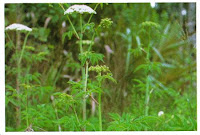 pretty plant, isn't it? It'd do to us what it did to Socrates- even touching the plant can be toxic. It's also called Water Hemlock and Cowbane- a beautiful plant that looks a lot like wild carrot, or Queen Anne's Lace; it could also be mistaken for the powerful medicinal Angelica. QR & I once pulled over into a little public park, where these beautiful tall white umbrelled plants were growing.... I wanted some for vases, but the stems were too tough to just break off, and I had no clippers or knife, so thought I'd use my handy teeth and just bite em off. I was bent over a stem when I noticed the purple splotches.... isn't there something about purple splotches and poison?!? Happily, I listened to myself, and didn't bite em- I'd be dead or very sick by now if I had. The purple splotches are an indicator of Hemlock; none of the look-alikes have em.
 pretty plant, isn't it? It'd do to us what it did to Socrates- even touching the plant can be toxic. It's also called Water Hemlock and Cowbane- a beautiful plant that looks a lot like wild carrot, or Queen Anne's Lace; it could also be mistaken for the powerful medicinal Angelica. QR & I once pulled over into a little public park, where these beautiful tall white umbrelled plants were growing.... I wanted some for vases, but the stems were too tough to just break off, and I had no clippers or knife, so thought I'd use my handy teeth and just bite em off. I was bent over a stem when I noticed the purple splotches.... isn't there something about purple splotches and poison?!? Happily, I listened to myself, and didn't bite em- I'd be dead or very sick by now if I had. The purple splotches are an indicator of Hemlock; none of the look-alikes have em.
So what to do? Don't touch or eat any but corporate plants in case we might be poisoned? I think NOT. We're clearly at risk from corporate foods, anyway- supposedly benign, nutritious lettuce, spinach and peanutbutter have already caused death and illness in the US this year. Best thing for forage plant safety is knowledge, and fortunately it's available to us. Books like Peterson's field guides are very detailed, with particular identifiers for each plant, so it's easy to identify the poison ones. There're many fine sites online, too- some with detailed photos.
Bottom line is- corporate foods or not- know what you eat.
Saturday, May 26, 2007
The Lilies Of The Field
Oh MY. I've been scouting out more edible "weeds" around here ...... we have purslane, lambs quarters, miner's lettuce, chickweed.... all reportedly high in human nutrients. They don't only grow in fields, either; purslane and lamb's quarters are springing up from our urban sidewalks, between the cracks of rubble piles, roadsides and the edges of downtown buildings... with the addition of pigweed seeds- amaranth, high in protein- maybe we CAN live off the lilies of the field, even in a city! 

this one's wild black mustard:
the seeds are used to make mustard,
and the greens are, yes, mustard greens.
the seeds are used to make mustard,
and the greens are, yes, mustard greens.

Here's purslane on the left- growing up from a well-traveled sidewalk.
 In the middle you can see a tiny little green sprout- I'm transplanting purslane from the sidewalk to the yard. One of the books told me that purslane has been known to sit neglected in a drawer for a few months- during which time it flowered and seeded- then grow very well after being simply laid down on rocky dry soil. We'll see.
 Tuesday, May 22, 2007
Growing Food In The City

I've thought that growing food or medicine in deep city environments is just about impossible. No room, no soil, no air, no good. Not true. It's so simple and effective that even I, with a real dirt yard to work in, am doing it. Here's how: take a five gallon container- like a paint can, a wastebasket, a box- and poke holes all around about five inches from the bottom. Fill it up with dry leaves or other dried stuff- I've used straw and miscellaneous garden clippings, too- to around three or four inches from the top. None of this has to be exact. Then put a few inches of soil  over that. Water it well. Then.... sow the seeds!

This is a closer-up of cilantro growing in a plastic bucket- it's healthy and delicious.
These pots need very little attention or even water. Once they're thoroughly watered, there's a resevoir at the bottom up to the punched in holes; the dry material wicks up the water and delivers it to the roots. We can see the plants get lower & lower in the pots as the material below composts, keeping the roots warm while it rots. The compost then makes good soil for the next growing season. PLUS they weigh maybe two pounds and don't drip water..... perfect for rooftops or indoor gardening.
 over that. Water it well. Then.... sow the seeds!
Here's a row of pots with cilantro, peppers, parsley and yarrow growing- we even found a volunteer wild tobacco ( attenuata, favorite of west coast native americans) growing in a wastebasket left over from last year's crop!


This is a closer-up of cilantro growing in a plastic bucket- it's healthy and delicious.
These pots need very little attention or even water. Once they're thoroughly watered, there's a resevoir at the bottom up to the punched in holes; the dry material wicks up the water and delivers it to the roots. We can see the plants get lower & lower in the pots as the material below composts, keeping the roots warm while it rots. The compost then makes good soil for the next growing season. PLUS they weigh maybe two pounds and don't drip water..... perfect for rooftops or indoor gardening.
Friday, May 18, 2007
Naturalizing food and Medicine
One thing I realized about centering my efforts on my own back yard is that we really can't take it with us. Knowledge, yes..... infrastructure, NO. If we were thrown out of the house, or it burned down, or we were earthquaked out of here, it'd all be gone. Or useless if we were far enough from here to count. SO I've begun trying to naturalize food & medicine crops.... aloe vera, tobacco & poppies so far. I save the seeds or cuttings and throw em out where it looks like they can grow- public access places that don't get regularly poisoned off and benefit from rain and other water run-off, like the sides of canals, railroad passings, and parks. We'll see how it goes- too soon to see any results yet. I think of Johnny Appleseed, engineers spreading California poppies across the land, the wild flower people who plant the roadsides; if this works- or maybe if it doesn't!- I'll try fruit trees next.
Fruit
We have eight fruit trees cheerfully growing fruit now- apple, pear, nectarine, lemon, olive,
  loquat,
 fig, and one grafted tree called "fruit salad"- it's got peaches, plums and apricots on the same tree. Also table grapes and native wild grapes.... the fruits are tiny & full of promise now- if they truly reach maturity, that's a LOT of food, so I'm learning about fruit preservation- jam and drying and brandy preserve are my favorites. We'll see how it goes!
 fruit trees cheerfully growing fruit now- apple, pear, nectarine, lemon, olive,
  loquat,
 fig, and one grafted tree called "fruit salad"- it's got peaches, plums and apricots on the same tree. Also table grapes and native wild grapes.... the fruits are tiny & full of promise now- if they truly reach maturity, that's a LOT of food, so I'm learning about fruit preservation- jam and drying and brandy preserve are my favorites. We'll see how it goes!


Subscribe to:
Posts (Atom)